 Pixelverse
 NFTs span TON avatar collections and Storychain’s announced story collectibles
Pixelverse NFTs include avatars from earlier game participation on TON and Storychain’s announced design for minting completed stories on Base. Early avatars connected participation with character customization and collection-specific benefits. Storychain’s design gives Farcaster replies another purpose: building a collaborative story that becomes a collectible when complete. Its NFT design credits contributors, while PIXFI rewards use the ecosystem’s separate token.
A character avatar represents a different kind of participation from a shared story. That difference affects the network involved, the meaning of rarity, and the benefit attached to ownership.
Key takeaway: Early avatar rarity influenced Black Puma’s documented mint probabilities; Storychain’s announced collectibles represent completed collaborative stories.
The agent, contributors, and story collectible
Storychain’s announced structure assigns different jobs to an AI agent, the people replying on Farcaster, and the completed NFT. The agent supplies the prompt and rules. Contributors add short fragments through replies, giving the chain its content.
Rules and contributions
The agent’s prompt
The AI agent defines the storytelling frame in the announced game. In September 2025, co-founder Kori Leon described higher NFT rarity for stories begun beneath popular or trending Farcaster posts. The described design allows the agent to introduce that game beneath a Farcaster post.
Contributors’ replies
Participants supply the story fragments that develop the shared work. Their contributions follow the game’s prompt and rules, so the finished story reflects both the agent’s framing and the replies that people add.
The completed story
Minting creates the NFT associated with the finished chain. Individual replies are parts of that work; the completed chain is the unit described as the collectible.
Farcaster threads and Base records
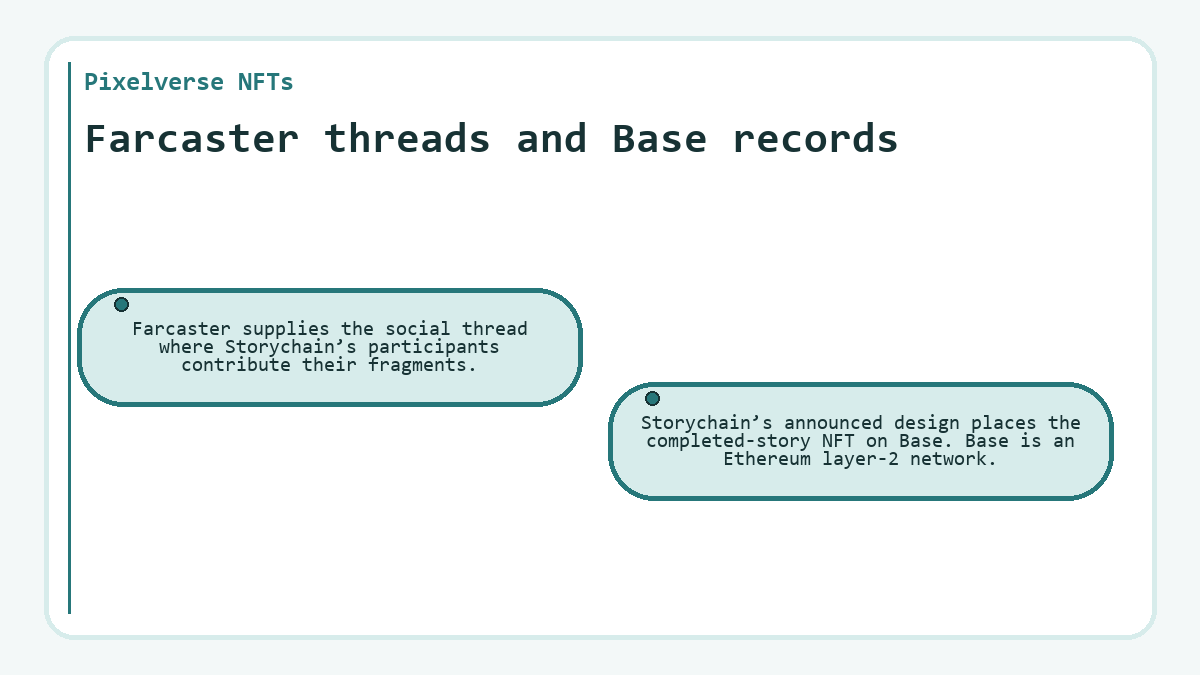
Farcaster supplies the social thread where Storychain’s participants contribute their fragments. Storychain’s announced design places the completed-story NFT on Base. Base is an Ethereum layer-2 network.
Storychain’s September 2025 rollout
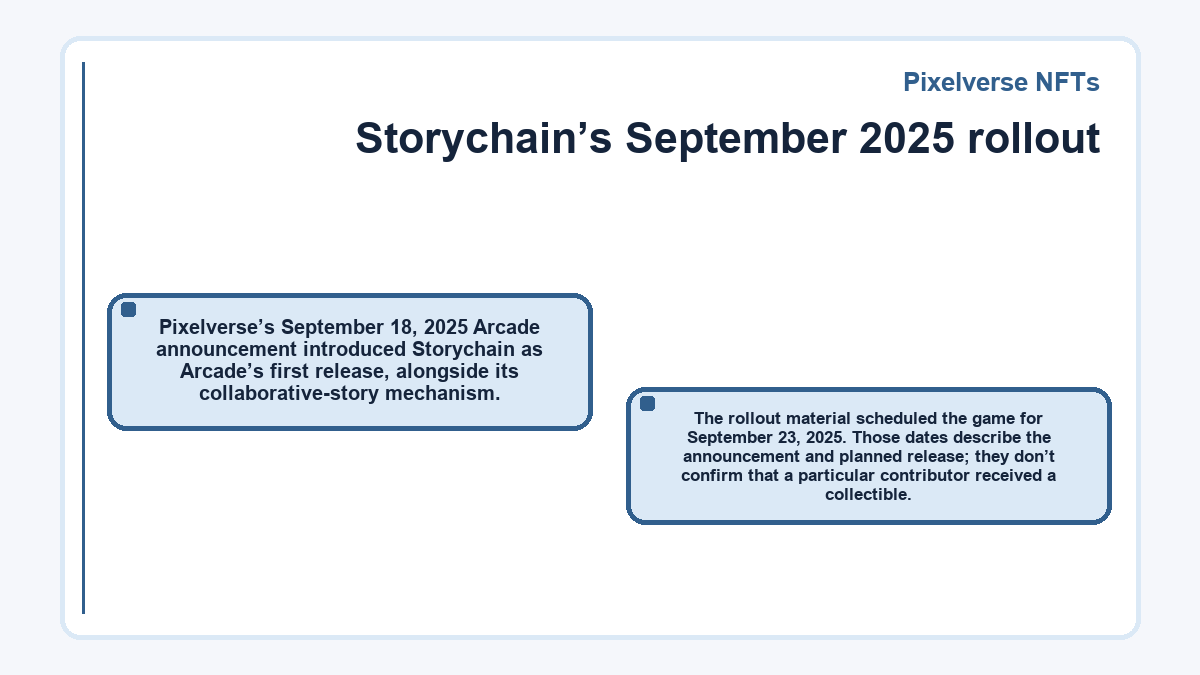
Pixelverse’s September 18, 2025 Arcade announcement introduced Storychain as Arcade’s first release, alongside its collaborative-story mechanism. The rollout material scheduled the game for September 23, 2025. Those dates describe the announcement and planned release; they don’t confirm that a particular contributor received a collectible.
Early avatars and participation tiers
Pixelverse Early belonged to the 2024 avatar rollout on TON, with allocations linked to PixelTap and Dashboard engagement. The original PixelTap rules used player levels. Dashboard allocations used bot counts, cumulative bot levels, and completed Demo Playground quests.
The Early rollout advertised character skins and, for PIXFI stakers, reward multipliers and higher odds of obtaining rare lootbox items. Those benefits belonged to that collection and its associated programs.
A later July 2024 update announced additional Common NFTs at levels 1-5 and additional Uncommon NFTs at level 6 or above. It applied to users who increased their level between PIXFI’s token launch and July 29 at 12:00 UTC. This supplemental award used different level bands from the original snapshot allocation.
Early avatar tiers and Storychain’s creation rule
The original PixelTap allocation used the July 18, 2024 snapshot at 00:00 UTC. Its level bands described avatar eligibility in that campaign. Storychain’s announced collectible uses story completion as its creation condition, so the avatar level scale doesn’t transfer across collections.
| Collectible or tier | Original allocation or creation rule |
|---|---|
| Common Early avatar | PixelTap level 1 at the 2024 snapshot |
| Uncommon Early avatar | PixelTap levels 2-4 at the 2024 snapshot |
| Rare Early avatar | PixelTap levels 5-7 at the 2024 snapshot |
| Epic Early avatar | PixelTap levels 8-9 at the 2024 snapshot |
| Legendary Early avatar | PixelTap level 10 at the 2024 snapshot |
| Storychain story NFT | A completed story chain under the announced Base design |
| Early tiers reflected 2024 game participation; Storychain’s announced design connects minting with story completion. | |
Black Puma’s link to Early avatar rarity
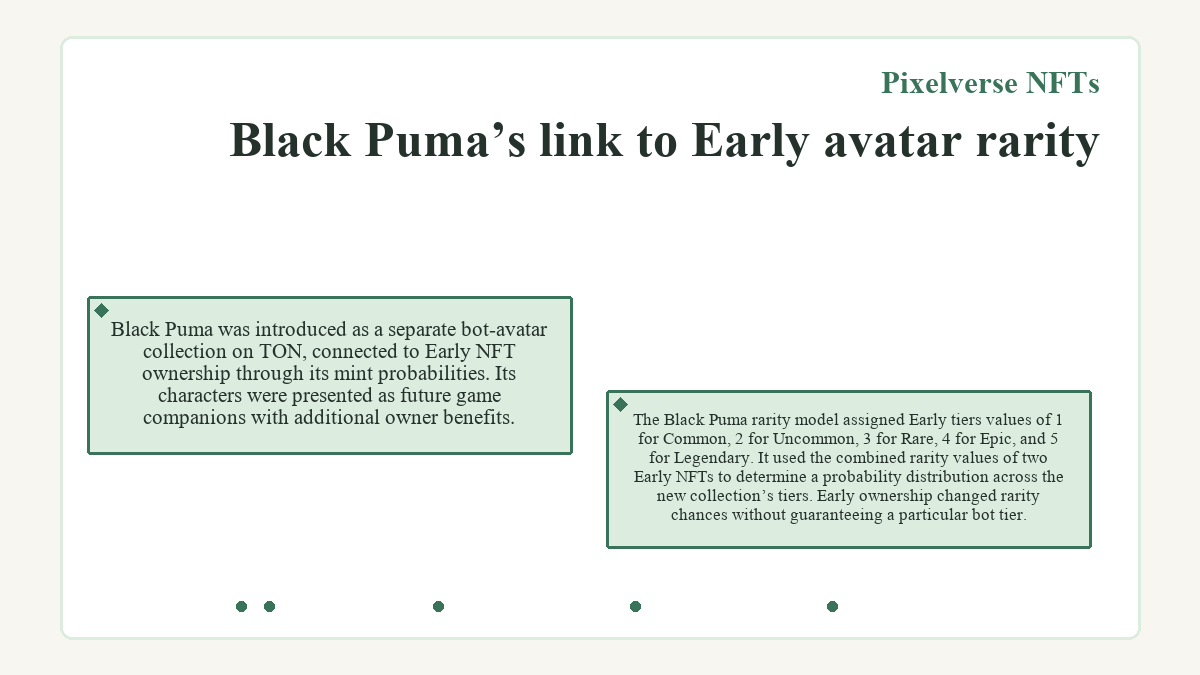
Black Puma was introduced as a separate bot-avatar collection on TON, connected to Early NFT ownership through its mint probabilities. Its characters were presented as future game companions with additional owner benefits. The Black Puma rarity model assigned Early tiers values of 1 for Common, 2 for Uncommon, 3 for Rare, 4 for Epic, and 5 for Legendary. It used the combined rarity values of two Early NFTs to determine a probability distribution across the new collection’s tiers.
Early ownership changed rarity chances without guaranteeing a particular bot tier.
Arcade progression beyond a single collectible
Pixelverse Arcade’s announced profile system linked activity across games with a seasonal Battle Pass. The September 2025 design described rewards, items, and achievements recorded onchain, with persistent progression across titles. It didn’t identify every profile action as an NFT mint.
A Battle Pass tracks participation within a season; a story NFT represents a particular completed work.
Meme-themed collections and playable characters
Storychain’s announced collections group stories around Pixelverse’s meme partners, connecting the completed works with recognizable communities. The theme organizes the collection; the replies supply the story itself. Pixelverse’s broader games also use meme-inspired characters, including Toshi, Brett, and MEW.
Shared names can connect those experiences, but they don’t establish that a fighter, its associated memecoin, and a story NFT are the same asset. In MemeBattle, selecting a character concerns its role in a squad; an NFT collection has its own ownership terms.
How do NFT benefits differ from PIXFI rewards?
NFT benefits attach to a particular collectible and program, while PIXFI rewards involve an allocation of the ecosystem’s token. The Early rollout advertised character customization and staking-related perks. A later closed-beta update added an NFT Player Aura, a visual character effect exclusive to NFT holders.
Storychain’s announced PIXFI pool was intended to reward participation alongside its collectible design. Receiving contributor credit on a story, owning its NFT, and qualifying for a PIXFI payment are separate questions. A reward pool doesn’t set a fixed conversion value for every completed story.
Do the 2024 avatar dates apply to Storychain?
Pixelverse Early’s announced 2024 dates concerned that avatar collection, with no shared schedule for Storychain’s later design. Its launch announcement set August 14, 2024 as the mint deadline and September 14, 2024 as the trading start.
Minting creates an NFT, while trading transfers an existing collectible between owners. An old trading announcement doesn’t reopen the original mint or establish access to a later collection.
Contributor credit and NFT ownership
Storychain’s announced NFT credits contributors. The description doesn’t specify how ownership is divided or assigned. Credit identifies participation in the story. Ownership concerns the holder of the collectible, and contributor credits needn’t identify that holder.
If you helped write the story, decide whether recognition is sufficient for the intended use, or whether that use requires control of the collectible.
Pixelverse NFTs: questions and answers
Could an Early avatar allocation be counted as a minted NFT?
Pixelverse reported avatar allocations separately from later mint totals. An allocation identified the reward assigned through the participation campaign; minting created its onchain collectible. Those figures described different stages, so an allocation total couldn’t establish how many NFTs had been minted or how many wallets held them.
Can two Rare Early NFTs guarantee a Legendary Black Puma NFT?
Two Rare Early NFTs didn’t guarantee a Legendary result in Black Puma’s published mint model. Each Rare input had a value of 3, producing a combined value of 6. For that combined value, the published model assigned a 1.20% probability to a Legendary Black Puma NFT. The figure describes that collection’s documented distribution, not a guaranteed result or a rule for other collections.
Where was the Black Puma mint offered during its rollout?
The Black Puma mint was offered in both PixelTap and the Pixelverse Dashboard during its TON rollout.
Did owning a Pixelverse NFT guarantee a closed-beta access code?
NFT ownership gave holders a higher chance of receiving a code during the closed-beta access campaign. The campaign distributed a limited supply of codes and required recipients to activate a code in the Dashboard. Holding an NFT was therefore a selection advantage within that campaign, without guaranteeing admission.
Was a Pudgy Penguins NFT required to play Pudgy in PixelTap?
The Pudgy integration let PixelTap players use the character without owning a Pudgy Penguins NFT. Character access and ownership of the original NFT collection were separate permissions.
Were Common avatars included in the first NFT-linked PIXFI allocation?
The original July 2024 allocation named holders of Rare, Epic, and Legendary early-adopter NFTs as the qualifying group. The program assigned that group an aggregate 10% of PIXFI’s total supply. That percentage described the group’s allocation, not an individual holder’s share. Common and Uncommon avatars weren’t included in that specified group; later campaigns had their own eligibility rules.